There is a version of strength many men know well.
Stay calm.
Keep moving.
Do not complain.
Do not make it worse.
Do not need too much.
Handle it.
For a while, this can look like discipline. It can look like maturity. It can look like being dependable.
In many ways, those qualities matter.
The problem starts when silence becomes the only version of strength a man is allowed to have.
Many men do not grow up being taught how to name what they feel. They are taught how to manage what needs to be done. They are taught to perform, provide, protect, compete, endure and keep control. They may be praised for not crying, not reacting, not needing comfort and not asking for help.
Over time, silence becomes familiar.
A man may not say he is overwhelmed: He may just work longer hours.
He may not say he is hurt: He may become distant.
He may not say he is afraid: He may try harder to control everything.
He may not say he is lonely: He may numb out, isolate or keep busy.
From the outside, he may look strong.
Inside, he may be carrying more than anyone sees.
How Silence Presents in Men
Silence does not always look like silence.
Sometimes it looks like irritability.
Sometimes it looks like emotional distance.
Sometimes it looks like sarcasm.
Sometimes it looks like being “fine” all the time.
Sometimes it looks like overworking.
Sometimes it looks like shutting down when conversations get serious.
Sometimes it looks like being the reliable one while quietly losing connection with yourself.
A lot of men do not identify this as a mental health concern. They may say, “I’m just stressed,” “I’m tired,” “I’m not good at talking,” or “This is just how I am.”
However, silence has a cost.
Unspoken stress still affects the body. Unprocessed emotion still shapes behaviour. Avoided pain still finds a way out. Stress is not just “in your head”; it is carried physically too.
Why Men Stay Silent
For many men, silence is not a personality flaw. It is a strategy.
A learned one.
If you grew up in an environment where emotions were dismissed, mocked, punished or ignored, you may have learned that staying quiet was safer. If no one asked how you were doing, you may have learned not to ask yourself either. If vulnerability was treated as weakness, you may have learned to keep everything controlled and contained.
Traditional masculine expectations can also play a role. Research on men’s mental health has repeatedly pointed to how norms around emotional restriction, self-reliance and “being strong” can delay help-seeking and make distress harder to recognise.
This does not mean masculinity is the problem.
It means some men have been given a narrow definition of strength.
A man can be strong and honest.
A man can be capable and supported.
A man can be disciplined and emotionally aware.
A man can be protective without being disconnected.
A man can be steady without being silent.
What Strength Actually Looks Like
Real strength is not pretending nothing affects you.
Real strength is noticing when something does.
It is being able to say, “I am not doing well,” before things break down. It is being able to pause before reacting. It is being able to take responsibility without drowning in shame. It is being able to tell the truth, even when the truth feels uncomfortable.
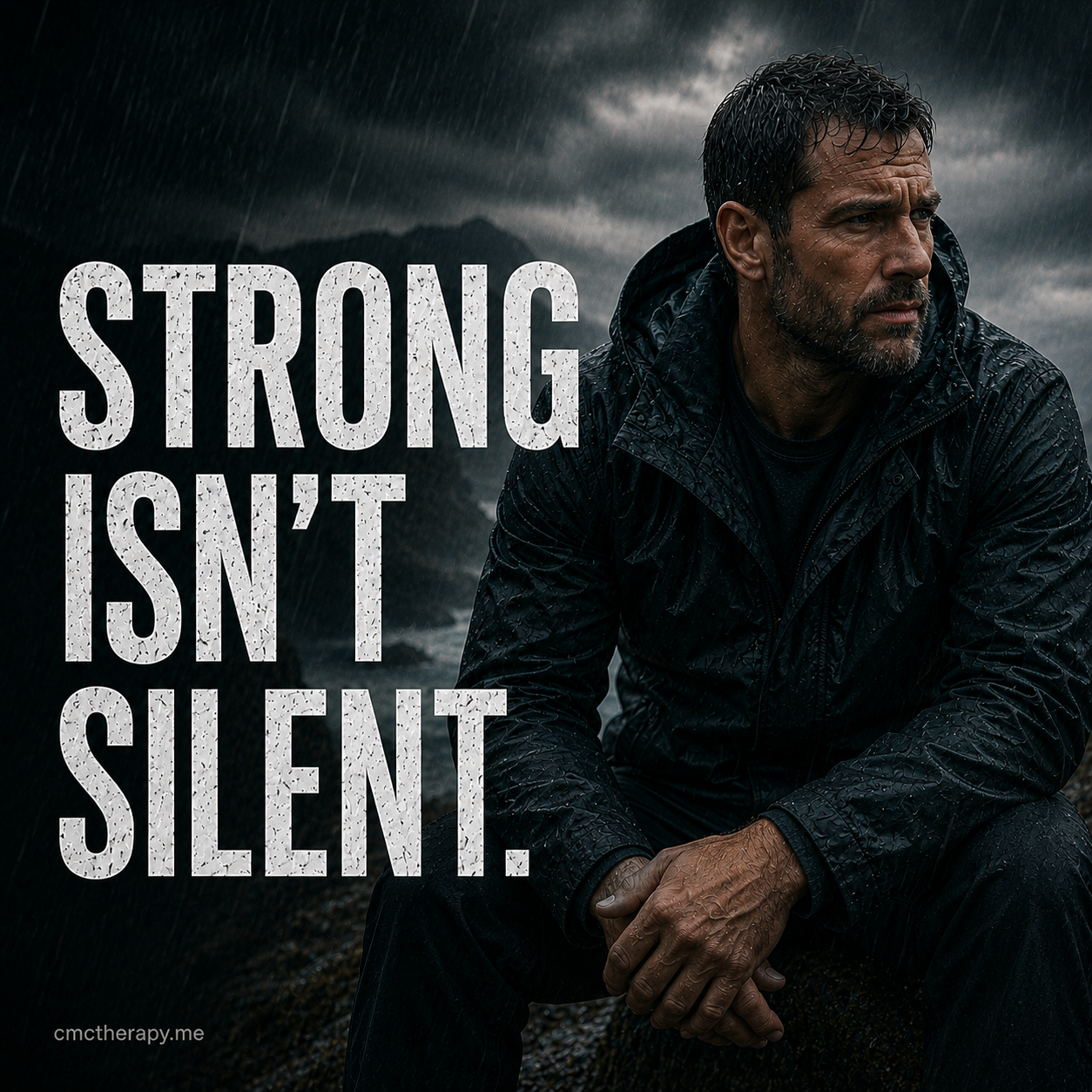
Strong is not silent.
Strong is honest.
Strong is self-aware.
Strong is knowing when the way you have been coping is starting to cost you.
A Practical Check-In
Ask yourself:
When did I last tell someone the truth about how I am doing?
Am I quiet because I am calm, or quiet because I do not know how to speak about what is happening?
What do people see from the outside vs what is actually going on inside?
What have I been calling “strength” that might actually be avoidance?
You do not need to answer perfectly. You just need to start telling the truth to yourself.
Therapy and Silence
Therapy is not about forcing men to become emotional in a way that feels fake or uncomfortable.
Good therapy creates room to understand what has been carried silently. It helps men identify patterns, make sense of reactions, build emotional language and develop practical tools for stress, anger, burnout, trauma, relationship strain and shutdown.
It is not about becoming less strong.
It is about becoming less alone.
Food For Thought
If silence has been your default, it probably served a purpose at some point, but the question is not whether silence helped you survive.
The question is whether it is still helping you live.
Strong is not silent.
Strong is honest enough to check in before the weight takes over.